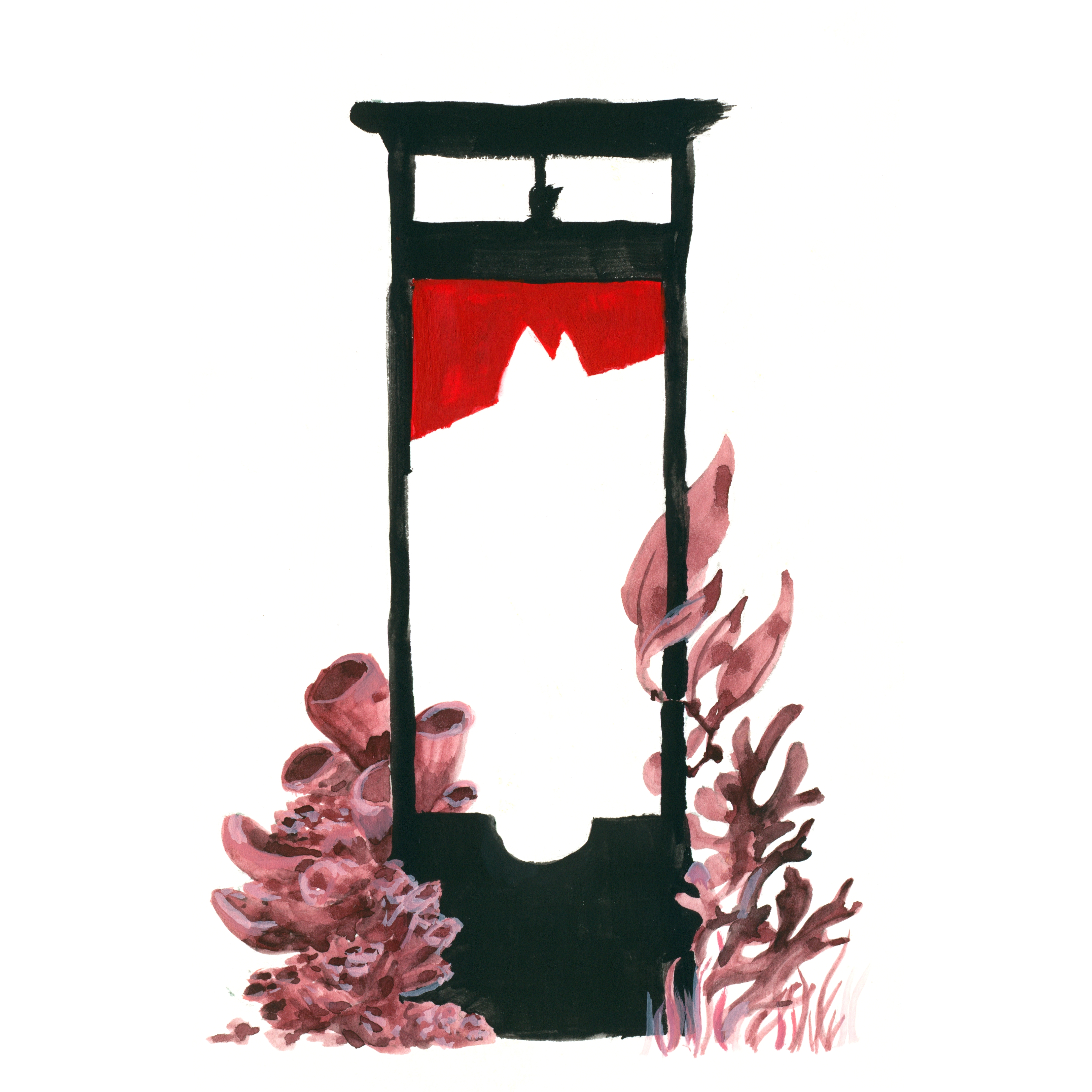
As they throw you into the circle of stones, you think to yourself,
This is just an execution in slow motion.
You’re surprised at the sheer number of people here, but figures that even in the modern era, an execution is still a spectacle. More surprising then is the lack of screens to let the audience get a good look at your impending demise. Instead, you’re on the top of a hill, while the crowd spreads in the valley around you, where they can all blink up into the brilliant sun of this beautiful day.
They push you to your knees, and you can’t help but think but I didn’t do anything. Just like when you were twelve and they hauled you into the principal's office for making fun of this one girl (—but you’d never even said anything to her, just laughed when your friends laughed and pointed at her uneven teeth and mismatched eyes—) and sure, you should’ve known better, but you never thought about it, about who it would hurt—
And now, twenty seven years later, as they join you in the stone circle now, isn’t it exactly the same? All you did was come up with an actually usable pseudo-random generator for the nanomachines, so yeah, Nanobright never would have existed without you. So yeah you got filthy stinking rich. Sure you always wanted to, but who didn’t? You never actually thought it would happen, so when it did you had no idea what to do, just followed the crowd who got stinking rich with you. And then they all got the Resaint treatment so you did too (—but it’s not like it was illegal, it’s not like it was even a misdemeanor, never mind a capital fucking crime— ) and now—
One of them steps forward, and given the forest and the hill and the stone circle, you expect them to have a big ol knife. But instead they've got a syringe and the liquid isn’t even black or green or putrescent yellow. Someone grabs your arm and rubs a spot on your bicep with an alcohol wipe, and honestly you’ve had rougher treatment at the doctor’s office.
But you know what this means, and you can feel the words fighting to get out of your chest. But I didn’t do anything. Don’t pretend you wouldn’t have done the same. I didn’t do anything, I just wanted to live—
You wanted to live forever.
Then they stab you with the syringe. Just a pinch and it’s over. They throw the syringe in a sharps bin and stand up. The crowd, all around the hill, is silent.
The woman who gave you the shot looks down at you and says two words.
“ Halichoeres sazimai .”
Both she and the crowd turn to leave.
On the flight home—because they’ve let the roads go to shit and fuck public transit on a day like today—you get a message. It’s Brent, who’s been with you at Nanobright from the start.
> They get you too, huh?
You don’t really want to deal with Brent. You want to get home and crawl into a hole and try to pretend that none of the last six hours just happened. But what the hell, you’ve just had your death warrant signed. There’s a chance going into death alone might be slightly worse than going into it with Brent.
“Yeah. Did the same thing happen to you?”
> Yup. Last week. I thought I’d be all badass about it and go all rambo on their asses but shit, there were just so many of them.
Some of the earlier ones had tried that—the first ones, the bigger fish, the kind of people who paid your salary—well, equity. Private security forces—public security forces, too, before the whole police sector came tumbling down. A lot of people died, and once upon a time that would have been enough. But something had changed: it'd been bad enough that there would always be some rich bastard, but now, now that it would always be the same rich bastards, forever?
So they took matters into their own hands. Specifically, they took you, and all the rest of the bastards rich enough to afford technological immortality, and they hauled you up onto a sunny hill and—
> So what did you get?
“What?”
> You know. The species. You got.
“I dunno. Some Latin bullshit. Does it even matter?”
Is what you’re about to send. But then you remember: now you die when the last individual of that species dies. So it really, really does.
Nanomachines are what signed your death sentence in more ways than one. Not only are they what got you rich enough to get the Resaint treatments, but the whole nanomachine boom is what made the Resaint treatment possible in the first place. The tiny machines repaired cell damage, corrected miscopies, and kept the biological machine running smoother than nature had ever intended, potentially forever.
Except, well, that Resaint had lied. To be fair, she told the truth. The serum’s nanorobots would indeed let you live forever, and—even before the moral arguments could really get going—those who could afford it were already reserving spots. But when Resaint gave you her patented immortality treatment, turns out it came with an extra bit of programming: one other genetic code. And if the froth of nanomachines scattered across the globe went too long without a sample of that species’ code, the machines that let you live forever would kill you instead.
When Resaint announced what she had done, she’d been disbarred, shunned, arrested. There’d been nowhere to flee: enemies of the state could find a friend in an opposing world power, but immortality had an international appeal. Within seconds of when she made her reveal, the rich and powerful of nearly every country wanted her head.
Resaint was dead. Suicide, of course. Two bullets to the back of the brain.
Equivalents to Resaint—minus the biodiversity curse—quickly proliferated, and the merely extremely rich—like you—flocked to them.
But Resaint had changed things. Maybe it was the media circus when she announced what she’d done. Maybe it was her martyrdom. Maybe it had nothing to do with her. Maybe it was the disbelief, the rage—that not even death, that final equalizer, would ever come for your private jets and your luxury clothes and your offshore accounts and—seemed to ignite something else. And even though Resaint was gone, her designs were not. In fact, they were everywhere. Specifically, they were outside the houses of the Resaint-alikes, demanding not quite their lives.
When you get back to your house, you make a beeline for your computer. There's no way in hell you’re going to remember whatever random animal (is it even an animal? It might be some weird ass fungus for all you know) that lady said to you, so you’ve got to google yourself instead and hope some obscure news channel wrote it down for you. These days though, these mutually assured extinctions happen by the dozens, so it’s not even news. In a panic you realize that not only is your lifespan now tied to the continuation of some random-ass species, you don’t even know which one.
You calm yourself down. All these people were there. There’s got to be some internet obsessive out there keeping track. You take a deep breath. You'll figure it out eventually. Whatever woodland creature or lizard isn’t going to drop dead overnight.
So eventually the adrenaline peters away, and you manage to fall asleep. Then, at some point in the middle of the night, you bolt upright and remember:
“ Sazimai .”
So, shivering, sweat-drenched in the AC, blinking in the blue light of your monitor, you meet your new life partner: a small, utterly unremarkable fish.
You try to focus on how the situation around your sashimi-themed execution could be worse, but honestly there aren’t that many ways.
The extremely important one is that Halichoeres sazimai isn’t endangered. But then you look closer and see that it’s only because the governing body hasn’t even gotten around to assessing it yet. A momentary panic fills you—you could be one fishy lifespan away from total apoptosis—but you work it down. Focus on what you know, not what you don’t.
Obscurity has its benefits. For one its trade isn’t prohibited or even regulated, but that’s about where it ends. Other wrasses are hugely popular among saltwater aquarium enthusiasts, but H. sazimai is a boring motherfucker. Just a gray fish with a single brown stripe. Just like dozens of other fish, which would be great if you were tied to the general concept of unremarkable gray fish. But unfortunately you’re tied to this specific one so unnoteworthy that even the aquarium enthusiasts haven’t heard of them.
And you’re getting well-acquainted with these aquarium enthusiasts. One of them in particular: a friend of a friend of a friend, who heard about your plight, and seemed to take to it. Not quite rich enough for the Resaint treatments himself, instead he’s devoted his fortune and more natural lifespan to saltwater aquariums. He showed them to you over video-chat, bright blue boxes aglow with flashes of greens, purples, yellows; corals of every shape and form. But it only depressed you, feeling as gray as your new fishy friend. But nonetheless, friend-to-the-third brought his guys who brought their guys, and—a lot of fucking rush order money and two weeks later—you have a thousand gallon tank making an absolute monster of your water and heating bills.
It's empty for now, but friend-cubed is having a blast reading and rereading the single scientific paper on your new friend H. sazimai . He explained to you that even though information on H. sazimai is sparse, there are several Brazilian saltwater favorites—like Gramma brasiliensis —which he can use to guess at the ideal conditions for H. sazimai by proxy. Unfortunately there’s no way to test said guesses against the real thing, because nobody is selling any.
Friend-cubed asks around on your behalf, but when it comes up crickets, just shrugs and goes back to happily ordering more live rocks and Brazilian gravel on your expansive dime. So it’s up to you to muck around with real time translations to Portuguese and phone calls with tiny saltwater aquarium shops at ungodly hours of the morning.
Nobody knows what you’re talking about, of course. But eventually you get a pointer to one of the guys who goes out on the boat. So then you find yourself trying to explain a scientific paper to a translation program that understands it even less, and from the face of the Brazilian fisherman at the end of the line, you know he’s getting barely anything at all, and all of a sudden the absurdity of the situation hits you in the face. You have to sit down.
“ Está todo bien? Alô ?”
It would be one thing if it was a fucking lion or a bear or even at least a sea horse or something. But instead, all you say is,
“Just everything. Get me every damn gray fish you can.”
That, the translation program understands.
You have to admit, something about being able to see them in the flesh gives you a sense of peace. One you realize you haven’t felt since your pseudo-execution. There’s been a tension in your jaw, a hitch in your breath. Now that you can see the H. sazimai with your own eyes, you can feel the tightness fade away, even though you’d never noticed it was there.
In practice though, you don’t know for sure if these particular fish are the ones keeping you alive. They look like the photos in the paper, but the paper also went on about look-alike species, so part of the process involved you holding down the wriggling things taking swabs of their scales to send to a lab. But now that they’re back in their tank, you’ve got a good feeling, watching them dart in and out of the rocky crags friend-cubed has sourced for you.
There are a lot of other fish in the tank too, most of the names of which you immediately forgot, since they’re not a direct factor towards your remaining vitality. A lot of them look a lot like yours, given your instructions to the fisherman, and those that don’t are a lot flashier. Wrasses are a brightly colored lot, with more hues and patterns than you’d ever thought possible for a bunch of fish. Friend-cubed had to persuade you to keep them—said that in the wild, wrasses tend to hang out with other similarity sized fish, so the variety would be good for them. Now that they’re here, you’re glad you agreed. It strikes you how depressing it would be, the twelve probably- sazimai wrasses in this big empty tank, all alone.
You sit down at your computer, which you’ve moved into the tank room, and start learning how to keep them alive. It’s going to be a long forever.
The first fish died three years in. You’d panicked—who wouldn’t?—and in a frenzy of research tried to figure out H. sazimai ’s expected lifespan. Consensus about actually-popular wrasse species was that 5-7 years was typical, but fish are weird. One species might fade in a year or so, but an adjacent species might have to be passed on to your children. There was no way to tell whether your dead wrasse had lived out its natural lifespan or succumbed to something else.. You aren’t sure which would be worse. But there were eleven fish left. For now.
For later, this illuminates a bigger issue. You thought they’d be breeding by now.
The lab informed you that of the dozen fish samples, eight of them were your coveted H. sazimai . The remaining four were similar but ultimately unrelated species. Three of those were male, the rest female. The dead fish, judging by the markings, had been one of the three males, leaving only two more shots to get your H. sazimai breeding program off the ground. Which, admittedly, had mostly been ‘put them in the same tank and hope for the best’. You call up friend-cubed, trying to keep the panic about your own uncertain lifespan out of your voice.
Unfortunately friend-cubed can’t help you, so you’re on to friend-to-the-fourth. Saltwater fish breeding is apparently a whole different horse race, which makes you kick yourself for not taking this more seriously sooner. You try to persuade—ie pay—friend-4 on the merits of H. sazimai , but apparently it’s a pretty bespoke process and he’s already full up on breeding fish for people in the same boat but with even more money than you. But he knows a guy who knows a guy who’s done some hobbyist breeding and might be interested in getting in on the billionaire preservation business. So now you’re on to friend-six, and you pay him a salary of 360,000USD a year to figure out who to persuade these damn fish to make fish babies.
But it turns out throwing money at the problem isn’t going to solve it. You fire friend-six and hire friend-seven, who, let’s be honest, is a complete stranger, and by the time the next male dies (and only one female has kicked the bucket) you’re paying three people simultaneously to try to get your H. sazimai captive breeding program going, and none of them are having any luck.
So now you’re venting to friend-cubed, who honestly at this point is actually a friend—his name is Pierce—about how unfair it is.
“Even fucking Brent is keeping his stupid cabbage butterflies. And they’re breeding like, well—just eggs, all over his greenhouse. And I know the bastard was a shareholder—a fucking shareholder—for half a dozen cryptoscams and gave his money to superPACs—and other than the Resaint thing the worst I ever did was some fucking cocaine that one time—”
Pierce just pats you on the back.
“It’s tough luck, buddy. Honestly we got lucky they took so well to captivity at all. The paper said they lived at twenty meters plus for depth, so I was worried they’d get sick or waste away. But you know, living’s not the same as, well, settling down. They’re surviving, but I guess it’s not quite good enough for them to start thinking about putting down roots. You ever think about kids?”
Of course you’ve thought about them. The same way you thought about getting a job, buying a house, the godforsaken Resaint treatment, too. The way things worked out, you had the money before you found a woman willing to tie the knot with you.
Though maybe, now that you’re actually thinking about it, maybe kids would have saved you from this fiasco. You’d only been able to afford the one treatment. And even as romantically and interpersonally constipated as you are, the thought of buying yourself immortality but not your children is a level of selfishness even you can’t stomach. Maybe in time and with some financial savvy you’d have had enough for two or three. But in all likelihood, you’d never have gotten the Resaint at all.
“Not enough,” is what you tell Pierce.
Four years later, the last of the males dies. You have three females left. There’s a tightness in your throat, like a tug from the world’s longest noose.
You’ve started to watch them a lot. It’s the first thing you do when you get up, the last thing before you go to bed. Every once in a while, you’ll fall asleep in the tank room, listening to the whirr of their pumps, the rumble of their heaters, and—your favorite—the occasional lap of water against the glass. Watching them still gives you the same sense of peace, but it doesn’t seem to last as long.
It’s obvious why. All of this won’t last long.
Your last male and the two females that went with him died within a few months of each other. Pierce and half a dozen other enthusiasts and experts gave the tank a clean bill of health, which was backed up by the thriving set of companion fish you bought for your wrasses. In other words, considering that it’s been five years, they’re probably coming up at the end of their expected lifespan.
“It's been a good run,” Pierce says. “Any first timer keeper would be proud.”
You nod numbly, wondering if your three remaining girls are flitting around a little less energetically than they used to.
You could get some more. No clue whether that one Brazilian fisherman is still in the business, but you could find another one. The problem is, recently you’ve been hanging around with Pierce and the other fish-people (of which you are both the least and most fish-like at the same time) and you’ve learned a little more about how the whole tropical fish business works. That they go out, into the densest parts of the reef, and they squirt fucking cyanide and all the fish get stunned, and usually none of them die. But that’s just what they say, the fisherman at poverty wages, pulling up as much as they can to satiate the endless global demand for these colorful living jewels. Jewels that, unlike diamonds or emeralds, never quite last. So you know that probably some of them die, and honestly even if they don’t, what’s the difference between a dead sazimai in the wild and the three that are going to die in your tank right here?
You try to remember how you thought they caught them, when you’d called that Brazilian fisherman seven years ago. But probably, just like everything else, you never thought about it at all.
In a lot of ways, it doesn’t matter. Your sazimai aren’t the only sazimai out there. Even when you have to scoop their bodies out of the tank and throw them in the compost (or maybe you should bury them in the backyard, like your parents did when your childhood dog died; mark them with a beach stone—gray with a brown-red stripe), they’ll still hopefully be out there, living it up on the coasts of Brazil.
You drive home from the bar, and your feet take you into the aquarium room. You sit there, bathed in blue light, in the soft and shifting caustics, and though it’s late and your body is screaming for sleep, the last thing you want is to leave—
You could do nothing. You could just go back to how you lived your life before, blissfully free of fish-themed activities, and just cross your fingers the sazimai to keep doing what they’ve always done: not die. And you could hope and pray that the world for you and for the sazimai keeps turning day after day.
You stand up. You shut the door behind you. In the morning you decide to move to Brazil.
Life is different here. It's not an unpleasant stay for your execution: with all the money you have, unpleasantness never has to last for long. But there are some comforts that even money can’t buy. Like overhearing gossip in a language you can understand, like chatting with your dad on your mutual commutes home. Like poppy-colored sunsets over the highway.
But time gives you new ones. The locals recognize you from the start, first from the mansão you had built prior to your arrival. Then, once that buzz had worn off, your daily drive to the beach, loaded up with scuba equipment.
After all this time, you still can’t say it’s the hobby you would have picked. But like everything else, you’re coming around to it. The hardest part is the beginning, the rubbery wetsuit, the clumsy fins. Then the plunge, still cold in the neoprene and tropical water. The disorientation, gravity-less. Blowing out the excess pressure in your ears, the splitting pain when you inevitably don’t do it thoroughly enough. But by now you know eventually you’ll work through the inconveniences, and it’s like you’ve been here all along.
It takes you longer to find them out here in the reef than it did in the tank, where H. sazimai made up more than half of the population. You take several trips out into the reef, floating in the dizzying whirlwind of tropical scales, wondering, after trip seven, if you’d been the subject of an elaborate scam via the dives you’d hired to verify the presence of the fish.
But, eventually, the Portuguese and the scuba and the ecology lessons start to kick in. You start to find your feet on shore. And then, one day, out in the water, there, in the shadows, at long last, you spot us.
This time when it hits you, on your own, thousands of miles from home in an alien underwater, it steals your breath away. Your regulator hitches. You choke and break for the surface.
You don’t know what to make of it, that feeling that nearly drowned you, and because it’s 6am back in California and Pierce—the only person you know who has a hope of thinking you haven’t gone completely mad—is probably still asleep, you show up in the local bar, forgetting you’re too embarrassed to speak any Portuguese yet. But the translate app gets you a beer from the bartender and, cold enough, all cheap beer tastes the same. You’re almost grateful for the language barrier. Because, when it comes to the feeling in your chest, you’re not sure even English is enough.
Over the next few months, even though you’ve had all your old furniture flown in, oddly it’s the reef that starts to feel like home first. So that becomes the place where you feel most like yourself, hanging suspended on the sunbeams, letting that feeling burrow deeper into your chest, as we dance and dart beneath you, waiting for the rest of your life to make sense again.
Sometimes you wonder if it ever will. But, as the local bar flies start to recognize you and offer you the occasional e aí , you remember how even though you never see us more than two or three at a time, we’re always in big hordes of fish of all shapes and colors. So you cross your fingers and start to believe that maybe things will work out after all.
It’s twelve years later, and your Portuguese is as good as it’s ever going to get. You kind of enjoy being the rich American eccentric. You stay young and the world ages around you, and by now everyone knows your story. You take their kids out snorkeling and teach them the scientific names of the reef fish, especially the little gray ones with the brown stripes.
By now you know us not just by our color and shape, but also the way we move through the water, our habits and hides. Even so, we’ve been getting harder to find. You don’t panic about this much, not like you used to. But this time there’s a strange heat in the water, one that follows you out of the boat, down to the bar, back home, and into the water again. This time, you dive a little deeper, scattering whorls of fish in your wake, though they quickly settle back around you again. You hover just a foot or two over the sandy bottom, and you feel the heat again.
Immediately, its source is apparent. Even though you’re only ten feet max away from the end of the reef, you can barely make it out: the normally crystal clear water is turbid, trapping the sunlight in the murky water. With your fins, you kick up a small cloud of sand, and catch a glimpse of a strange cluster in the sand.
Years of scuba diving has taught you more about managing your anxiety than any of the therapists you’ve paid, so with an underwater calm, you swim some feet away and give the sandy bottom that you and H. sazimai know so well another deliberate kick.
Again, through the cloud of sand, the mottled texture of something dark, hard. Something you’ve never seen before.
You repeat the exercise three more times. Then, on the fourth, you dive down and pry a chunk up out of the sand. Clutching it to your chest, you haul yourself back up into the boat.
Out of the neoprene and the fins and the goggles, and onto the waterproof pleather of your speedboat (in dire need of replacement after twelve years of daily use), you give your discovery a closer look.
Obviously not rocks, as you expected. They’re some kind of shellfish, clinging together in a dense clump. Even after the swim upward, they’re still pouring sand onto your seats.
Even though you're no ecologist, immediately and intuitively you can feel what this means for us. Our clear water, where reef meets sand. The turbidity in our gills, as we feed, mate, spawn, not killing us, but disrupting the patterns that have sustained us for generations. And that disruption, as you know from that small population we gave you years ago, could be more than enough to end every last H. sazimai on earth.
So there, blinking salt water from your eyes in the blinding sun, on the verdant coast and piercing blue sea, you contemplate your mortality again. Same as you did on that hill nearly twenty years ago. You remember thinking to yourself that it was an execution in slow motion, but twenty years later you have no idea if it was faster or slower than you expected.
A couple of the people who’d been Resainted had died, in those twenty years. Brent was one of them. A wildfire evacuated him from his Los Altos home, and the cabbage butterflies couldn’t come with. By then Pieris deota was nowhere to be found in the smog of those high Himalayan valleys. Brent had lasted nearly a decade after, before some secret cadre of the butterflies had at last met their end.
His funeral had been more heavily attended than you’d have expected. A lot of Nanobrite people, of course. But in the wake after, a surprising amount of entomologists. Even a minister from India’s Ministry of Environment, Forest, and Climate Change came to give his condolence to Brent’s shocked widow—herself subject of the kingdom Dendrotriton rabbi , the Guatemala bromeliad salamander—never having imagined she would outlive her husband.
You wonder who might show up to yours. Your dad died three years ago. By the time the clams did their work, who could say if your mom will still be around. Pierce would probably be there, maybe not out of affection but at least shared responsibility. Maybe the scientists who named us—they’d stopped by once or twice, you think they liked you—
You’re spiraling now, and you know it. There are real things that can be done, to save both our skin and yours. You use them to ground you. You point the boat to shore.
When you get the lab results back, you laugh so hard you feel sick. Hiatella azaria , aka Zara Raschid, Senior Director at the Neuropeer Foundation.
H. azaria , endemic to the oleaginous Gulf of Mexico, had had enough struggles of its own, facing outcompeting visitors from bilges the world over. But somehow, the whims of the same shipping industry that had nearly killed it had granted it, and Zara Raschid, a whole new second life. At the expense of only your own.
Well, maybe not just your own. You find the wiki of the Resainted and look up the species you recognize from the reef. To your surprise, the two decades since your own sentence, almost all of them have had people assigned to them, even the ones you’d have thought were too populous to be a satisfying death sentence. Your jealousy flares—the Atlantic is filthy with queen angelfish—but you push it down and start pulling on your network.
You get a lot of redirects, a lot of dead ends, and at last, a lot of secretaries promising to get back to you as soon as possible. You don’t feel great about our prospects, but it’s better than nothing.
Closer in, people are more responsive to your plight. The ecologists are alarmed and thank you for the early warning. They accompany you to the reef, not just your favorite, but the other six or seven spots you’ve found over the years to visit us. The spread of the clams is widespread, and they’re able to put to words what you’ve felt in fear: the clams unsettle the sediment as they feed on the particles trapped within. The sediment, stripped of nutrients, clouds the water, not only obscuring the sea floor from the bottom feeding fish, but also increasing the temperature, which in turn unsettles old rhythms the whole reef over. The damage is not as bad in some places, but it is widespread. It’s early yet, the ecologists reassure you at the bar afterwards, washing the salt water down with beer. There is still time, there is still much that can be done.
The new faces at the bar draw a crowd. In breezy Portuguese, the ecologists explain your plight, and the chorus of ‘ multo ruim ’s resound. But, as the drinks flow and the machismo grows, soon comes a half-baked plan to bring up the whole town and pull the H. azaria up by roots like weeds. The ecologists giggle and say it won’t work, but they debate amongst themselves drunkenly and admit it couldn’t make things worse. And if ever it would, why not here, why not now? What was prevention, if not the readiness to try any cure?
And now, two weeks later, that’s why you’re standing out here on the crowded beach as the whole town splashes out into the reef in 2 dollar snorkels and ill fitting fins, ready to pull up some clams. Parents scold their children to be careful while they dare their friends into the water first. The water is golden brown as divers kick their way down to the sea bottom, then surface, splashing, holding handfuls of sharp shells. The younger children dangle off the boats, grabbing the clumps from their older siblings and parents hands, depositing the masses of shells in the floor of the boats, til they are piled high and the fishermen dump their catch on the docks or to spoil in the sand.
Further from the chaos and laughter, the ecologists are testing a borrowed dredge. They ask you for your help to watch underwater and gauge its effectiveness of uprooting the H. azaria. You watch but, like the swimmers, it’s hard to say if they’re making any real progress.
All the same, for the second time in twelve years, something new and unnameable rises in your chest.
The event continues until dark. The town builds big bonfires on the beach, and inevitably someone tries to cook the H. azaria . Most are too small to eat, but the largest roast deliciously, bubbling in a saltwater broth til their small mouths open, like they’re gasping for air. You’re offered the first bite. You try to decline but they insist. As you watch their faces of the town flicker in the bonfire, the symbolism finally kicks into your waterlogged brain and you accept.
It’s glorious on your tongue, but then you bite to chew and immediately spit it out.
In accented Portuguese, you choke out, they’re filled with sand.
The whole beach laughs.
There’s plenty of beans and rice and beer so the merriment continues unperturbed. Music and dancing continues until the bonfires burn low. The crowd begins to peel off to return to their normal evening lives, leaving you alone with the waves and the last crackles of the bonfire.
“Harold Sawyer?”
You startle to hear your name. It’s the first time in god knows how many years you’ve heard it in an accent other than Portuguese.
The woman who sits next to you is tall, thin, with a ghost of a sunburn in the firelight that marks her immediately as not one of the locals. You don’t remember her from the swimmers or the ecologists, but from the salt encrusting her hair, there’s no doubt she was part of the day’s activities.
“I’m sorry, I don’t think we’ve met.”
“My apologies. I intended to introduce myself earlier, but it’s hard to find someone out in the water.”
“It was a mess today,” you say.
“Yes,” she says. “But in a good way. I’m glad I caught you in the end. My name is Zara Raschid.”
The name flits in your mind for a moment, trying desperately for its home. You find it just as she starts to fill it in for you. You speak at the same time.
“ H. azaria .”
She smiles at your unabashed surprise.
“What—how. Why—”
“You invited me. Well, not directly. But you know who close knit our industry is— everyone hears everything. But it was very thoughtful of you, to let all of us know that our species might be at risk.”
No one had responded, in any meaningful way at least. A few personal apologies via the executive assistants, but the little collision between the wrasses and the clams couldn’t really make it up above the floor of executive inattention. You’d written it off as a useless endeavor.
But apparently not completely.
“I thought—of that whole list—you were the last person I expected.”
“Why not? I’m more directly related than anyone else there.”
“Yes, but we were killing yo—them, by the bucketful!”
Raschid shrugs and pulls a cooked shell off a discarded plate. She raises it to her lips and swallows, grimacing at the gritty texture.
“You're not worried about it happening to you?”
Again she shrugs. “I suppose so. But before Resaint I would’ve died eventually anyways. Even with H. azaria I could still be hit by a car. I’d rather live, obviously. Otherwise I never would've had the Resaint at all. But living has never really been up to me. Though these days I hope I make it long enough for this one.”
She puts her hands on her stomach and it takes you a moment to figure out what it means.
Forty years of ingrained politeness leaves you all at once. “You’re pregnant?”
You’re glad to see she’s amused rather than angry, at least.
“But one day,” you say, “won’t you have to watch them die?”
“Maybe. But hopefully she’ll want the Resaint too—”
“And all this? ” you say, and she knows what you mean. Not just the H. sazimai and H. azaria , but the anxiety and the lack of control and—
“I’m hoping they’ll give her something from the Gulf, like me.”
“That’s mad. You’re mad. How could you wish this upon your own daughter—”
She doesn’t seem to react to your accusation. “Maybe you haven’t realized it since you’ve been living down here in Brazil—not that I blame you, it’s lovely here—but these days that’s what the Resaint means: a species to steward over. I signed up for that. And so do others, in droves. It costs a lot less, mind you, but for a lot of people, this is what they want. It’s not even about the immortality or eternal youth any more. It’s about—” she gestures at the bonfires, the last of the dancers, the sand, the sea, “ —this . After all, would you really want to live forever, without it?”
And, as you think back on the town, the ecologists, and us, waiting—hopefully forever—in the dark sea, you find that you agree.