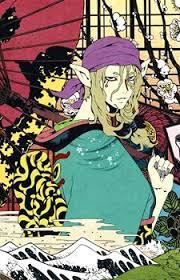
Katachi. The form of the world is the island alone in the circle of the sea.
He lives there with his mother and father. He has no siblings, but he isn’t lonely, because the island is too small to afford the distinction between stranger and friend. It’s a fishing village, because the island is little more than a rock outcropping and can’t support any more plant life than what the inhabitants cultivate in sparse gardens with varying success. Periodic trips to the mainland to sell their catch are usually allotted to a single man, called the Boater in gratitude. The waters around the island can be dangerous, and when the community is so small, losing too many takes too long to recover. The Boater is left to make his voyage, and the village waves him away and breathes a sigh of relief when he returns. The island is safety. The water is danger. The choices are simple here. They are the ones they must make in order to survive.
Makoto. One day the Boater returned, and with him was a man ringed by the gold of the sun.
His world is encompassed by three layers: water, horizon, and sky. Where water becomes horizon, where horizon becomes sky, and where the sky becomes horizon and water again is his eternal puzzle, which he cranes his neck and spins around to inspect and ponder. He asks his parents about these three girdles of the universe, but his child’s words can’t quite articulate the sliding between of up, down, and around, and how the sunlight swims across the sky during the day, before sinking into the opaque horizon and sliding beneath the waters that gradually run clearer and clearer as they approach the islands and set up nests in rocky tidal pools. He can’t articulate the solidity of the dome of the sky—like the shell of the egg of some giant bird—nor can he communicate the infinite thinness of where the sea becomes sky—like a spider’s thread, and the way in sunlight it seems to be in too many places at once—and the fading of color of the mercurial seas—so like the graded dye of his mother’s favorite kimono—represents a magic that he can’t hope to ever enunciate.
The Boater was the business of the adult world, which was so very far from his wonderings. He had asked the Boater before his questions of the horizon, sea, and sky, but the man would only ruffle his hair and belt out a laugh before turning to talk with a parent of one of the children of island. His frantic words struggling to catch the rattling of ideas in his mind often won a similar sort of reaction from the rest of the adults of the island. The children found his musings dull compared to their games.
But one day, while sitting in a cliff-side pool to watch the sunset bleed through the horizon and into the sea, the smudge of a boat appeared in the dying fire. As it drew closer, he could see the hunched over figure of the boatman, crouched so low as to disappear into the boat, and the silhouette of a man, sitting perfectly still, blotting out the golden sun as it passed through sky, horizon, and sea all at once. To young eyes, he was a man sent from the sun, the sole traveler of sea, sky, and horizon.
Kotowari.
He sits on the great and vast sea, beckoned across by the calling of the Isle of Japan.
His robes are blue-green, like the sea and sky. He carries a wooden box with faded edgings of goldish gilt. Inside are packets of medicine, which he has come to administer to a child of the island who has recently sickened. After his work is done, he sits on the roadside and pulls wooden toys from his wooden box and hands them to the children who are fascinated with the simple wooden mechanisms. Another child, however, remains when the others have run off with their tops and tricks, and asks him to pull from his blue-green memories the truths of the blue-green sea and sky and horizon, so he speaks.
He tells of the way the sea can roll and roil and push into the sky and the horizon becomes naught but white foam. He tells of birds that fly over the horizon to where no land lies yet return every spring. He tells of sky and sea so white with fog and clouds that where one begins and the other ends, that that which is called the horizon is all around you, and when you reach out to touch it, it swallows the form of your hand and your fingers leak into the fog until you pull them back and they return to you. When the Boater goes out to sell the village’s catch, the medicine man and the child watch him disappear over the horizon. This time, he sees the sea and sky stretch around the humble vessel and the horizon extending beyond it to the infinite.
That evening, the medicine man speaks with his parents. He has grave news about their child’s health, but the child doesn’t hear the talk of the terrifying fate in store for him, because the medicine man’s going to take him on Boater’s boat to show him the never ending sea and the ever fleeing horizon. His parents are hesitant—they don’t understand why he has to leave, why can’t the medicine man bring the cure back instead of taking away their son—but it doesn’t matter, because even though the medicine man gives them until the next time he visits to decide, when he goes out with the boater the next day, he’s accompanied by the child with blue-grey eyes that are drinking in the color of the sea.
Katachi.
The form of his world is the isle of Japan and its endless dusty roads.
The medicine man died before he did, despite never finding a cure for his childhood illness. He left behind the chest of medicine and the knowledge of its contents and the same blue-green robes from so many years ago, though they’re beginning to fall to pieces at the sleeves and he can’t bring himself to throw them away or patch them up with the coarse brown fabrics commonly worn by his customers. But his practice begins to profit—there’s something in his face that gets along well with people—and he can afford those rich fabrics. Even so, when he makes the extra stop at the markets, he can’t ever find the right hue.
Now that the chest is his, he can pull out the drawers one by one and hold each dried leaf and root up to the sunlight and whisper its name and lay it out carefully on the dusty inn floor. He pulls out the wooden toys that had beguiled the children of his village all those years ago and pushes them aside without a thought. Last, he opens the box bound to the top of the chest, which he had never seen the medicine man open even once. Inside, there’s yet another box, this one heavy red, embellished with gold and gems. He is surprised only that this discovery does not surprise him. He glances down to the gold flecks of paint on the largest drawer. There isn’t enough to make out the design. He imagines that medicine chest must have gone from back to back from the day some medicine maker profited vastly and painted the signs of his wealth onto its source. And in the top box, what would there be? He brushes the dust out of the compartment before finally opening the box. For a moment, he sees something glitter within, but there’s nothing but dull red silk. The lid of the box closes heavily, and suddenly he feels there’s more gravity to the decorations than just some rich merchant’s display of wealth.
Makoto. While wandering without destination, he finally reaches the cave where destiny is contained.
In the mornings, he is compelled to rise early—before the sun comes up—and abandon his home for the evening. The golden god of the sun waits beyond the tree line, slumbering beneath the foliage, but calls out to him in the frantic coloration of his dreams, promising worlds more than just the green, brown and gray of the archipelago’s nature and those that live not far from it. He is frightened, apprehensive, scared to venture outward, but buried not so deep the exterior wealthy merchant is that child and his whispers of three words and the excitement and magic running in currents infinitely long, infinitely thin.
He feels guilt that it sleeps so ungracefully, talking in its sleep, within him. He feels guilt that, every time it awakens, he whispers that the sun is not up yet, go back to sleep. He walks in the child’s place when the east blossoms with all the colors of this quiet land and then pushes past and explodes. If the sky were dyed in vats deeper than the ocean, the horizon is the clothesline pulled taut and let loose, flinging the sky out from the waters for the world to see.
One day, as he pushes past the trees in the half-light of the half-asleep, drops of dye fall down upon the earth as the sun rises above it. They run down the curve of his cheek and the line of his nose and widen his eyes, for at the moment, the world changes—tilts a degree in its revolutions about the sun about the galaxy about the center of this too-bright, too-dark universe—and his widened eyes see the seas of color that he sails on in his dreams, and the horizon is a cave from which spills out heavy gold light where the sun, sole traveler of the sea, sky, horizon sleeps and lies in wait for him.
When he finds the cave, it is dark. He runs his hands along the walls to see. But the feeling of blindness isn’t new to him. These days, it seems that he wears a blindfold, just thick enough to cut out the color of the world. But when he finds the corpse, for a moment, he thinks he sees a man of gold, spilling light, with currents of fire thrashing about him, and his voice lashes the flames in and calms them and they settle like the sea after a storm. Though the vision disappears, in his head it leaves the stories of ghosts which he never knew whether or not to believe and how it came to be that there was a man who took it upon him —not to kill—but to put them to rest. He picks up the sword and the world roars into color, and the blood of the mononoke dyes the trim of his robes.
Sometime between the flashing of the sword and the bursts of color, or maybe even in those moments where he feels himself falling deeper into the darkness of half-existence, replaced by the heavy gold of the being that is both separate and the same, both familiar and foreign to him, while he sits in the unsorted turmoil of his mind and struggles against the preconceptions of this universe, there is something of him that is lost. He still sells his medicine. But the smiles have been replaced by stares of fascination. The laughter is forced. He can tell they’re afraid, and they don’t want to show it. But he still sells his medicine.
He takes a look in the mirror shortly after. He doesn’t recognize himself. Something in him snickers.
Kotowari . When the archipelago of his home grows small, he rides again above the sea and over the horizon.
The years pass in strange gulps. At times it seems that he moves not from day to day, but from mononoke to mononoke , unraveling the pain of their birth before bringing about their death, and then moving on, to new truths, new miseries.
His narrative is nearly dreamlike, and the never-ending battles steal from him the moments spent on the road, moments napping in the sunlight, moments spent immersed in the crowd. Flowers on the road side, windswept clouds, the smiles of strangers all slip between his fingers. He is forgetting the sound of his parents’ voices when he hears a familiar name while traveling down a familiar road. The drive which chains him to his task abates, for the moment, and he changes course for the port town where he said goodbye to the last face of his childhood.
He tries to hold in the wildflowers, the smell of the salt as he crests the final hill. For a moment, he sees the sandy paths and thatched roofs before the reality rips through his memories. Buildings tower in the sun and sulk in each other's shadows. Concrete sweats puddles of oily water. People move quickly through the streets, and avoid each other's eyes. The smell of diesel and garbage overpowers the sea. By nightfall, neon signs have burned away the wildflowers. The mononoke howl, glut on despondency, and the memories of his homeland slip from his mind.
A great time has not passed, but the mononoke have been slain. The city struggles through its daily toil peaceably, though it will not last. The mononoke will return, crawling forth from the city’s quick-running current of thick discontent and anguish, hungry for justice according to laws incomprehensible to human minds. But for now, he and the city can rest.
He sits on a flowered dune and watches the sea. A face he recognizes joins him.
She introduces herself, but he doesn’t hear a word. The tilt of her chin, the insistence in her eyes, the childish lilt of a laugh in her voice, he recognizes it. He knows her. It’s her , it’s…
She asks for his name. She doesn’t remember him. He doesn’t remember her.
He doesn’t give his name, but asks of an island, only far enough from the shore to hide behind the horizon.
Gone, she says. Swallowed by the sea. Long, long ago.
Long, long ago, he repeats.
He stares into the sea. How long has it been since he watched the waves pass beneath his eyes as he left his home for the first and the last time? How long has it been since he took up the sword? How long has it been since should have died, should have been swallowed by the sea?
A shadow covers the sun. A metal bird shrieks across the sky. It careens over the ocean. He watches it disappear into the horizon.
And he realizes that his love for the land of the birth has lost all relevancy. There is no one for him here. No home, no family. Just streets and streams, faces and fields he has seen, chasing after the comforts of familiarity to be met each time with confusion, fascination, distrust at his strangeness. He is clinging to his memories in the hope that he will not be forgotten. But he has been forgotten. Long, long ago.
The sun traces the plane’s path, balances a moment on the wire horizon, and plunges into the sea.
Yes, come after me, that voice says, terrible in its dispassionate hunger for blood. Chase me, to new lands and new miseries.
The next plane screams and rockets into the startlingly blue sky, and he is there, chasing the limits of the horizon. Under the roar of the engines, he hears his other self whispering hissing excitement for the new world, for blazing through all lands where the sun has touched.
But despite the voice’s forward looking, he peers backward through the fingerprinted plastic, watching the islands he has called his home disappear into the horizon. For so many years he has walked its roads, watched its lives, listened to its stories. As it grows smaller and smaller, he imagines that all of it, its faces and history, its tales and myths, its seas and skies and everything in between, can fit there, in the hollow of his hand, and that its influence in him is similarly shrunk. And save for the small island of archipelago memories centered at his heart, he feels vast and empty.
Like an island ringed by the sea. Like a plane chasing the horizon. Like the sun, no bigger or brighter, alone in the huge, blue sky.
Katachi. The form of the world is the earth and all it consists of.
His tongue is flavored by the languages of the world, and his breath by its spices. Into his skin is ground the mud and sand of every continent, and when he knocks on their doors and offers them a solution to their ills, they can see, hear, smell, taste, feel the mystery of his history, the immense age hiding under his young exterior. They stand aside and let him in.
For there is both a wiseman and a trickster in the genetic memory of every culture, and no matter how the lines of race and ethnicity have blurred, there is nightmare after nightmare lurking in the minds of men, one that grows more fearsome the longer it is hidden from denying eyes. They see his attire, immemorial and nostalgic of times long since lost, and the wiseman invites himself in. They see the marks on his face and his supernatural smile and the trickster reminds them why he’s here. The trickster steals their guarded secrets to light and the wiseman quiets the raging nightmares. And then he disappears, like the magic once the story ends.
The medicine seller himself has long since accepted what he must become to slake the thirst of simmering fire within him. The obi has become the orarion , the kushti . The bandana has become a chaperon, a wide-brimmed hat. The robes have changed their cut countless times, but still remain as blue as the sea. Sometimes he feels the endless newness of the world welling up around him, threatening to overwhelm him, to drown him, to crush him finally in their angry, hungry jaws…
They are not just mononoke now, but ghosts, monsters, witches, and demons. Their forms are varied, wild, described by thousands of names. He must learn these new cultures, new fairytales and ghost stories, to learn them all. The events that create them are nearly as strange, taboos broken that he had never considered as such, acts of monstrosity beyond his imagination. The world is big; its myths and people are bigger. But some things never change. He still loves her despite her indifference, she still hides her pain under a mask of strength. A child abandons his parents, a mother enslaves her child. There is hate, regret, pain lurking under the guise of normalcy, just as the supernatural lurks under the mundane. And so he continues, unearthing their stories and the monsters born from their myths. He has seen all the plays of life, and though the faces of the actors change, their hearts do not.
The whole world is his homeland, with a different face, but the same heart. He is the same man, and as time rolls on, his face must change, but something stays the same in his heart.
And then the fire in him crackles, and burns, and laughs.
I will not change , it laughs. Never, not .
Makoto. In his darkest moment
At times, he is certain the end of his time has come.
He has long since grown used to the rapid pace of change, especially under his long-lived gaze, and while he no longer expects to find familiar sights, at times, their absence wearies him. While he is enough at ease in his surroundings wherever he is, the strangeness is a reminder that worries at the peace of his mind.
For, he has not always been and, unlike the constant sea and sky and horizon, unlike the eternal sun, must one day end. He was born as a human, and continues to be human, no matter how strange the paths he travels. And as a human, he is certain he must have inherited the promise of mortality. Yet the promise remains unfulfilled as countless lives pass before him—lives no greater or lesser than his own. Even the mononoke—walking gods, monsters, breathing legends—find their end, often at his hands. Why should he live on? He is distinguished only as the vessel and wielder of the sword, which reached his hands by what seems a strange combination of coincidence and fate. He had not been given the sword, nor had he sought it out. Rather, he had merely lived his life as it presented itself to him until the chaotic concurrences of his life suddenly disentangled themselves and unraveled to reveal to him the man of gold. He cannot understand why he was chosen, but he is certain that one day, his favor will end and another will take his place. He thinks on this and cannot tell how he feels.
But when the modern world constricts—ties him tight with its love of procedures, identification, its institutionalized distrust—he cannot help but think it is the end of unexpected charity, the means by which he has operated since the beginning and cannot think to change. Gone, too, are the closed-door days of personal secrets and family shame. Now the rips and tears and claw-marks worm themselves into the hearts of entire communities, cities, spidery networks on which behemoth governments and corporations and institutions are built, which grow monsters as huge and terrible as what must fall when—if he manages to slay them. Because, as the veins of communication spread wider, thicker, growing over and around themselves, the pathways for the mononoke to walk spread as well. He may clear the misery of so many hearts, but a thousand miles away, the same wound still festers, and the incidence of such widespread desolation births monsters wild in form, amalgamations of the hatred of hundreds, distorted by cry after cry for justice. They crawl between skyscrapers like seething dark clouds and he guards himself against their many limbs, claws, misshapen and writhing, all the while begging from their terror-struck, denying, blame-ready mouths for truth. Please, the truth—the makoto, the katachi, the kotowari —
And when the sword won’t unsheathe itself and blood loss dizzies his mind to the point where he feels it being sucked into the mononoke’s kaleidoscope-patterned, kaleidoscope-minded mass, when he takes one too many would-be fatal blows, he must ask:
Why? Why have you chosen me? Why won’t you let me go?
There is no response, and so he must force himself to his feet and turn his questions in on himself.
He has never questioned his path, why the twists and turns arose as they did, and why he chose one path over another. Regret of these choices is an ache which has plagued many minds, but never his own, not until now, when shock throws his consciousness from his body to among the spectators who watch gape-mouthed as his frail body tumbles from blow to blow, clutching his diminutive sword, and he must wonder what kind of resolve has held him to this absurdity. Why he continues when someone more literate in this newer world might be better equipped to fight this battle—why he, a stranger to all of it, must fight, must bleed, must face down death for these small moments of humanity, mired in the misery of their lives.
But then the lies fall away, like smoke and storm clouds over the sea, and there is beauty beneath. The haze and the clamor fades and beneath he can see their brief kindnesses, their passing generosity, their evanescent love, like the glimmer of sunlight off the motions of the sea. They last no more than a moment, but in whole, their light is blinding, as bright or brighter than the sun burning in the skies above.
The answers to his questions are still as much a mystery, but in the clarity after the fray, he knows there are answers, and one day he will know them, and, for all the fury of his daily battles, he is assured there is peace, somewhere beyond the horizon.
Kotowari . When mankind’s hand reaches into the infinite, his own is there to take it.
There was only one dream, one nightmare, left to him.
His dreams of color and light left him when he found the sword, purpose fulfilled. Now, when he closes his eyes for sleep, he sees the instant where he picked up the sword, and something huge, something whole, something entire, changed, and in that moment, he could see it, all of it. He caught glimpses of foreign worlds inconceivably far away, and personal worlds eternally unreachable. And he saw his place in them. He saw himself as soldier and healer, as invader and guest, as murderer and hero. And he saw the infinite spaces, the interminable distances between where he is and was, and what he is and was, and he is afraid. He is afraid of losing himself in that emptiness, of becoming nothing, in the midst of nothing.
After all, what was it that stood in this darkened room, watching the moon rise above the treetops? Surely it was the same man that had watched the sun do the same over the forests of Japan of such a long time ago. But he knew now that all matter breathed and he was not the same stuff that he began as. Ideas and memories did the same and changed the mind to which they belonged. Who was he, that wore a thousand faces, spoke a thousand tongues? That knew story after story of life after life? As he had walked this world, battling the mononok e at every step, each truth he had discovered had cost him a small part of his self, lost as he struggled and succeeded in understanding the grotesque tales of their birth. His own past is lost, somewhere in the deluge of human life that he had touched. All he has is his duty, his battles, and the man of gold that binds him to it.
And his questions. In his dreams of darkness, when all the light is pulled from him to burn flaming against the mononoke , they wait for him, a glimmer of self that he clings to. The ponderings of his childhood still lived there, joined by the questions of his work—the katachi, makoto, kotowari. And together, they allowed him to see something of the path of his life, bewildering journey that it is, but also something of the fabric of lives through which it wound, like a current through the sea—how he has shaped this multitude of lives, how it has shaped him. How events in both distant past and far future have come together to create who he is and what he does. The tides of fate have been building for so long, from so many directions, and pressing inwards and waiting, until the three questions of his childhood opened the gates and let them in. There is a grand design drawn from both chaos and fate, as richly textured and vividly colored as the world which it describes, and in the darkness and in his doubt, it grows bright in his mind.
Humankind has torn open the skies. They are abandoning their seas for those on strange, new worlds. They will travel through the darkness of infinity to moments of light as brief as the span of their own lives, yet somehow just as eternal. There are no limits, no horizons for mankind, and so there shall be none for him.
He does not even need to board the metal needles that puncture the skies with their tails of fire. Instead, he, in that darkened room in the moonlight over the forests of Japan, simply closes his eyes, and knows that when he opens them, he will already be there, waiting for them in their new worlds, in the minds of men, to heal and to hurt, medicine seller and warrior, both myth and man.