I can recall nothing of the fire, and I suppose this is why my sister and I grew apart.
I can imagine it vividly, though. Thick orange tongues against the sky. Fire trucks and ambulances rushing in, hampered by the idle movements of the gathering crowd. The fire, in the dark, magnetic. My sister, me, and mother, watching dumbly as our house burned. The scope of the destruction—photographs, keepsakes, memories, and home, burning—kept at bay by the fire’s flickering dance.
But the image is soundless. I cannot hear the murmurs of the crowd or the crackle of the fire, and the sirens scream silently against the dark of the sky.
There is no stillness in a public swimming pool. Overcrowded, all waves clang senselessly against the ceramic sides. The ocean’s constant movement is no different, yet manages not to sicken so much.
All sounds are muffled and distant, under the sound of water.
Someone sat next to me, but said nothing.
Like me, she had changed into her swimming suit, but had no intention of entering the water. I wore a t-shirt and had my wallet in my trunks. She had a sweater and a scarf. Our feet fidgeted away from the damp linoleum floor.
Her hair was long and trailed nearly to her waist. Its color was a deep, thick red. She stared unblinkingly at the sky. I shut my eyes. We both sat in silence, trying our hardest to ignore the sound the water, uproarious in our ears.
The quality of the water’s splashes changed, punctuated frantic sounds of human panic. A boy, from the grade below mine, struggled and screamed, his voice burbling and intermingling with the waves. She was faster to react than I.
In one fluid movement, she was in the water, without even the smallest of splashes. Her hair blossomed around her like a corona. It seemed to stain the water red, like blood.
Her name was Sheila and she believed that she was already dead.
“Then why did you save him?”
She and I waited for the bus, which was slow to come for those of us who lived on the coast. We were in the same grade but none of the same classes. She was known for her beauty, but also her distance. Someone had lent her a sweater to replace the one she had worn into the water and discarded, heavy with water. She wore the same scarf, even though it was still dark with damp.
“He died, anyways.”
I had seen Sheila and the three of them talking, the boy’s parents breathless with thanks. Their child, dry but still shivering, was wrapped and warm between their arms.
“What are you talking about?”
She paused, fixed her full attention on me. She spoke.
“There was water in his lungs, more pressing down his throat. Every frantic breath only drowned him further. His arms were already growing too heavy to move. His legs sank him like stones as they searched for something to stand on. In another world, I watch and he drowns.”
As she spoke, I could feel my throat constrict. Something cold dripped its way down my spine.
The bus pulled up, breaks whining as it came to a stop.
“But in this one he lived.”
She shrugged and boarded the bus. “You nearly died once, too.”
The cold feeling on my back spread and started to burn. I reached over my shoulder. The skin of my back was hot and damp. I was sweating, but my hands felt like ice.
In another world, Markus drowns. We all leave in heavy, shocked silence. His parents weep in the infirmary, and communal mourning mutes all activity at the school. But Markus had lived, and the school was still moody and silent.
I boarded the bus.
I never knew my father, but both my sister and I take after him, white-blond hair and translucent skin. Whether he left her or died, my mother would not say. That was in her nature--to lock tragedy far away, where she could not see it and believed it could not touch her.
Our home was small and falling apart. We bought it that way, promising ourselves to fix it up. A promise broken from the start. As it stands, its only virtue is its view of the sea.
In the early morning, the tide is low and borrows the air’s own quality of silence. A figure made its way down the beach. Her hair billowed like a flag in the wind.
I ran down the cliff face, bare-feet alternately sticking and slipping on the beach-washed rocks. I managed to land feet-first on the sand. Sheila had seen me and was waiting.
“How did you know, that I had nearly died?”
She stared, impassively. She and I were both wearing white. The wind snatched at our hair and clothes. I was cold and shivered, but to her, the wind's cold was a second skin, and moved around her stillness, around her posture and her sky-grey eyes. For a moment, I was convinced she could hear the undercurrents of my secrets, buried so deep that not even I knew them.
But then she blinked and the moment passed, and I heard only the quiet murmurs of the sea. “Was I wrong?” she asked. “They don’t make you swim,” she said by way of explanation. “And you never take off your shirt.”
“Yes,” I said. “It wasn’t me—my sister—” I couldn’t look at her or at the water, so I stared down at my feet “She walked off into the ocean and didn’t come back.”
“I’m sorry.”
“When I came back to school, I didn’t feel like swimming. They didn’t have the nerve to tell me otherwise. I never needed the practice anyways—my sister and I used to come down to the beach nearly every day.”
“And you haven’t since?”
“No.”
“You’re here now.” She looked at me curiously. “You live up there, don’t you?”
My house was just visible over the top of the cliff face. The lights were still dark. “I don't know why we never left.”
“The sea is magnetizing,” she said. “It’s impossible to look away. We’ve filled it full with our romantic notions and our tragedies. The water here is so heavy it’s a wonder we sink at all.”
She turned her head over her shoulder, watching the waves. There was a hollow pain in her eyes. I could feel the same, where it struggled inside my chest. When I turned my eyes toward the water, it seemed to magnify and sharpen, burned at my skin.
“Her body, they never found it, you know.”
I wasn’t sure why I told her. It took several minutes for the fullness of my emotions to catch up to me. I had returned from the beach and had my hands on the faucet, filling the kettle, when they started to shake. Mother woke hazily and did not notice.
Grief, in this house, was heavy, but silent. It made what words we said to each other sound muffled, our conversations strained and shallow. In my mind, this hidden sadness raged all the louder for it, but in mother’s, it might have been just as silent as it seemed. It takes a certain mind to push out pain to that degree, but mother must have had practice, however she lost her husband.
She had told us, long past when we outgrown our interest in such things, tales of the sea-people—dew-eyed men and women with saltwater instead of blood, who could sing storms with their gale-like voices. But they could be caught, tricked or beguiled, and would give up their skins and their life at sea for love. Lose the webs of their fingers, the seaweed from their hair, the depth from their eyes.
But these stories rarely ended well. A fish wife belonged first and foremost to the sea, and must return to it by story’s end—the strength of their love was never a match for the allure of a tragic end. These tales left a bitter taste in my sister’s and my mouths. Perhaps from the look of unadulterated wonder in our mother’s eyes.
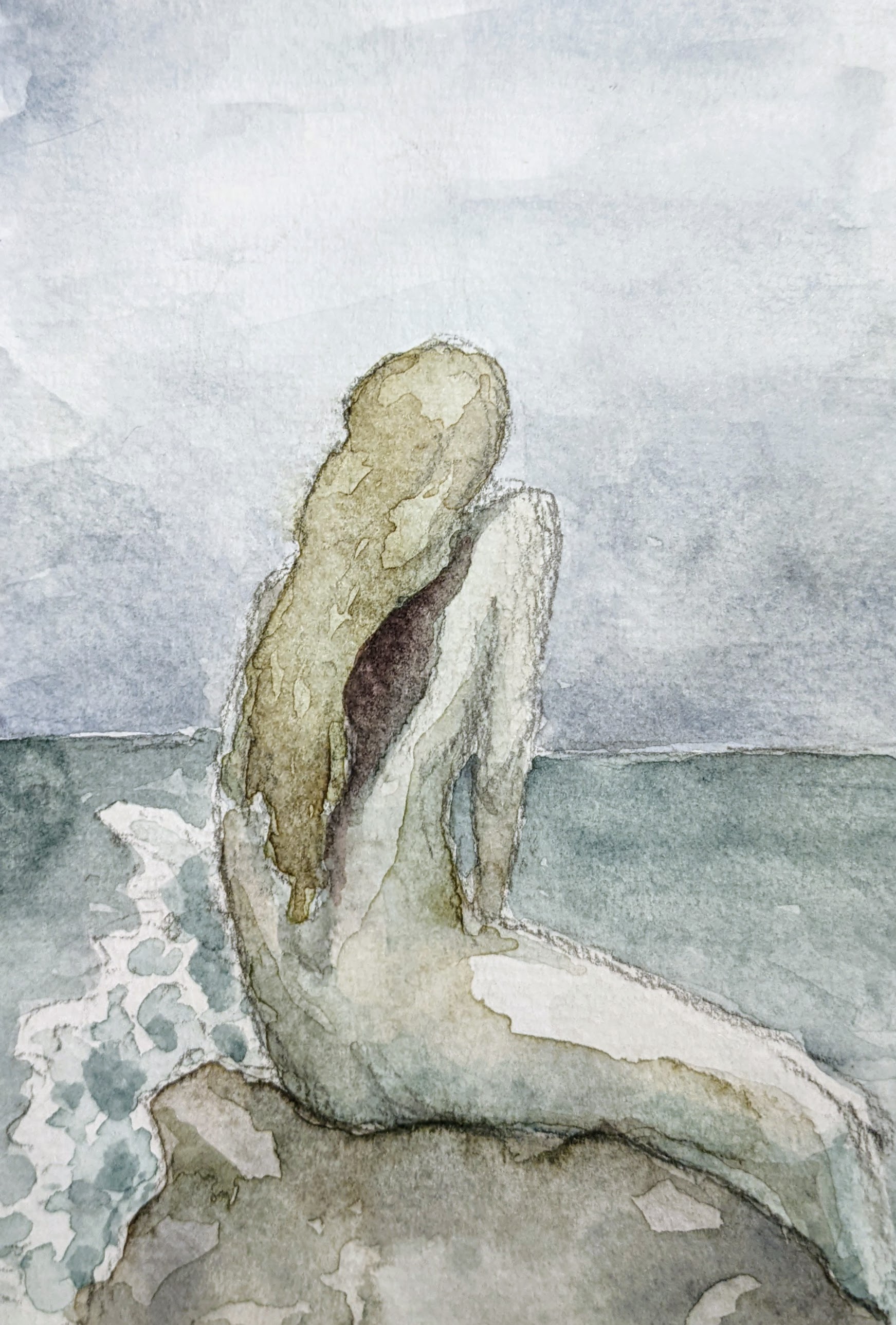
It would be easy to believe that she was one of these sea-people, my sister. She and I had taken to the water like a second home. The memory of her—she slipped soundlessly between the crests of the waves, legs stretched long in the water, skin as white as the belly of a fish, hair fanned out behind her—was bright in my mind.
Not bright enough though. My image of her shuddered. She gasps for breath, throat above the water still but convulsing, splitting open, gutted. No blood spills but yet more water as she struggles. Her hair, colored as the sea, stains red.
The water was hot, and scalded my hands as it overflowed from the kettle. I jerked them away and rubbed my lips against the irritated skin.
That must have been how my mother escaped from her grief, why we still lived in sight of where my sister died. She believed that one day she would come back. Shed her sea-skin and skip back to land.
The thought made me sick. My skin crawled.
“Why do you think that you’re dead?”
The bus dropped us off in view of the sea. Today, the gray skies mirrored the furrows of the ocean. The sun hid somewhere behind one of the two. The seaside air was cold. I had my coat, Sheila her scarf, entangled like a ribbon in her hair.
“The same reason that that boy can be dead. And you, too.”
Both our homes were on the coast. We followed the road downhill.
“Even when you’re still here, doing things that living people do?”
She stopped, and turned her eyes skyward. “Our lives are full of choices, paths branching off from each other. But we have no sight of them, where they diverge and converge or even come to an end. They bring us so close to death sometimes, but not close enough. And what’s left is so—painful, ugly, undesirable, what’s the difference between life in this one, or a ghost in another?”
There was no trace of melancholy in her expression, but her voice was full of it, heavy and sweet. I heard old bells in it, echoing as driftwood echoes old ships and faraway churches battered on the beach.
“I didn’t think you’d tell me—not honestly like that.”
“I didn’t think you’d tell me about your sister. But I thought it might mean something to you.”
“Even though you’re dead?”
She smiled. “Yes.”
The seabirds called from a distance down the coast. For several minutes their meaningless conversation was the only sound between us. We came to the shore, where long grasses spilled over the brown gray rocks, marking the line of the beach. The cliff face was less sheer here and the smooth boulders sloped and tumbled straight into the tide. I knew from experience that even at low tide and far beyond, the path did not give way to sand.
The rocks darkened the water above them and seemed to form a dark road into the sea. Sheila saw me falter and stopped and turned to me.
“Was this where?”
I nodded. Our cottage was in sight, further down the coast.
Sheila removed her shoes and stood barefoot on the rocks, cold, smooth and soft with salt and dew from the sea. She turned to face the sea, staring down the patch of darkness until it dissolved into the gray of the horizon.
Sheila reached out a hand towards me. Uncertain, I took it. She pulled me up onto the rocks.
Somehow the wind seemed higher here. I shook, but Sheila's hand was still and cold in mine. She stepped down to the next stone and and curled her fingers against my palm. I followed, my protests insistent, but far too far away.
I watched my feet against the rocks. I followed Sheila's footsteps as they passed from stone to stone, barely landing before alighting again. My own were clumsier, growing more uncertain as I lost the difference between my feet and Sheila's, and started hearing footsteps that were neither mine nor hers.
My sister, I realized. These were my sister’s steps. A crevice yawned between us. Sheila leapt easily over it. I swayed, stumbled, and fell.
Wordlessly, she stepped back over the crack and knelt beside me. The skin of her hand was pale and stone-colored. She reached out to pull me up by the shoulder---
I knocked her hand away. She seemed startled.
“Sorry,” I said, and struggled to sit upright on my own. Sheila retracted her hand, and sat beside me. She wrapped her arms around her knees. I ran my fingers along the dry grooves in the rocks, where water had run long ago.
“My sister used to draw lines along the ridges of her ribs,” I said, at last. “When I asked her why, and she said that she couldn’t breathe, that the air was too thin.” I could feel my chest tightening. “Years later, she'd drawn the same lines in her skin with a razor. I found her cleaning the blood off the bathroom tiles. When she saw me, she didn't say anything. She just looked at me, sighed, and shut the door.”
“Is that why you never take off your shirt?”
“No,” I answered easily enough, but something flickered and writhed inside my chest. I pushed it from my mind.
Sheila unfolded her arms and stood. Her scarf caught the breeze and billowed behind her, like wings.
“You must think that I’m obsessed with death,” she said. “But I feel trapped by it. There is an infinity of parallel universes, ones where we live, ones where we die, ones where we were never born at all. They must all be crowded together, like drops in the sea, and all just as indistinguishable.” Suddenly, she pulled her arms to her chest. Her hand clutched at her throat, as if seized by a spasm of pain. She turned around sharply.
“It wouldn’t be a bad way to die, to give myself to the sea.”
“You can't,” I whispered. Her hand was at her throat. Panic, fright, held mine.
“You can,” she said. She stalked closer, one hand slipping under her scarf, the other towards me, reaching to touch my back—
There was a wail from up the hill. I fell shatteringly back to clarity. Mother was calling down the cliff-face, unintelligible with tears. Two policemen looked down from the roadside. Sheila's hands remained at her neck, stroking the skin beneath her scarf.
Mother's screams reached me, garbled by wind and by water. Three words which I could not hear, but did not need to. Sheila must've known them too, but said nothing.
They found her, I said, feeling ice slip up my back. My sister, they found her.
The morgue echoed. Its walls were cold and water condensed and dripped down its unfeeling surfaces. I walked unsteadily beneath the weak fluorescent lights and felt shadows sway liquidly around me. A white sheet masked a silhouette on a waiting table.
The coroner murmured to my mother, and she wailed ascent. Nothing had ever sounded farther away. The sheets rolled back.
We take after our father, fair-haired, thin-skinned, blood as pale as the sea. We blush blue and our eyes are dewed. Our skins are pristine, as cold as the shock of the waves. I did not need to touch her to feel the chill rush through my limbs.
More murmurs, more wails. I heard them diffracted, and their meaning arrived too late when I realized what they meant to do.
There is a certain truth that so far I have only been able to perceive with fogged eyes, which I have shied from clearing. But the air here is brittle and stark, and I see it now, in the shade on her white-stretched skin, puddled in the crevices of her shoulders and neck. The shadows there are too deep, too black, too red. The coroner grabbed her shoulder and pulled. Her arm hung limp in a moment of graceful animation. Then, he turned her over, and she fell.
Her back was angry, red, rot. What flesh there was was black and torn by the hungry mouths of countless fish and the ruthless waves. Flashes of skeleton surfaced white from scorched furrows of decay. The void seemed to burn and bubble at its edges, hungry, consuming the surrounding skin.
Face deformed against the table, skinless, my sister watched. My back burned. I felt bile rising in my throat. I had no breath to scream, ran on stumbling legs.
The faucets spilled sound and water, but still it was not enough. Something was surfacing, and I could no longer prevent it. Memory breached, and I bared my back to the light.
I can recall nothing of the fire, and I never will. I was mere gasps away from death, smoke in my lungs and fire instead of skin. I wouldn't have lived, but my sister and I had our father's eyes, hair, and and we had his skin. And though I lost mine in the fire, she gave me hers to save my life. And from there, all unravels.
Bleached by the morgue lights, the pallor of my skin could not hide the ridges that traced around my back, like a thick, knotted seam. My shoulder blades fanned and muscles shifted beneath it, but the skin of my back was not mine. My sister was dead outside on a slab. Her skin lived, breathed, and sweat over the hollow growing in my chest.
She loved the sea. For her it meant something that it would never come to mean to me. But when the skin the doctors cut away would not grow back, it was lost to her. A memory addled by drugs, returns, and my sister screams and tears at her hair against the tyranny of a concerned mother, to return to the sea. Her back is a mass of red, hurting flesh, poisoning her with its pain. I hear the words she has screamed roil under the rush of water, where they have sounded for years and years.
I cannot breathe. The air is too thin. I am burning, I am drought. Let me swim again, let become as salt and foam. Let me touch it again, the above is too loud, too bright, too clanging and harsh. You will not do to me as you did to him. I am strident and struggling, let me dissolve again.
So she drew lines along the ridges of her ribs with knives instead of pens. So she pushed her face into the sink until her lungs nearly burst from lack of breath. So she walked into the sea as the salt stung her open back and the waves destroyed her, watched by the brother who had stolen her skin, and forgotten.
Mother found me and turned the faucets off. I put on my shirt and we left, eyes burning, but dry.
There is no stillness in a public swimming pool. Lights dance off the waves and color the shallow water; all movements are small and constrained and produce cramped rhythms that are poor mimicries of the sea. But already, it's too much. I sat with my back to the air and my pockets empty. Hushed whispers joined the words under the waves when they saw my scars. Sheila found me quickly.
She knelt down in front of me.
“It poisons all taste for this one, you said,” I said to her. “Thinking, if only. It poisons all taste for this one--this life.”
“Yes.”
I could barely hear my voice through the sound of water. But Sheila's voice cut through in sonorous rings that had a chill of its own. I shivered as she pulled my hands from my lap and placed them over the thin fabric of her scarf.
“Underneath,” she said, twisting my hands closer to her skin.
One, two, three, four , I counted, on each side. Slits between feathered skin, three fresh enough that I wondered how she didn't flinch, and one worn smooth.
“You saw your sister again,” she said.
“Yes,” I murmured. Something wet collected in the lines of my palms.
“She was still beautiful, wasn't she?”
Once I might've recoiled and snapped my hands away, but the horror I felt at hearing her speak of death was far, far away now. Instead, I just felt the small way she seemed to flutter under my hands, unmoving, like something caged.
I met Sheila's eyes, and they were deep and strange. They danced now, incomprehensible and hungry. “Yes,” I said.
She smiled. “I thought so, too.”
She pulled the scarf from her neck. It caught some updraft as it left her hands and floated above the humid air to what was clearer above. I unfolded my hands from where she had placed them around her neck. The cuts glistened a fiery red.
She ducked her head as alarm bubbled up around her. As they pulled her from me, I could see how her wounds whispered and breathed as she spoke. Like small mouths against the white of her skin, I wondered how they found the taste of air.
In the horror and silence that swells in the face of death, Sheila spoke. The cuts on her neck glimmered brightly, like flaring gills. Her bones were thin and fluted, and barely weighed anything against mine, which were heavy and curved, shaped to collapse and bear the weight of deep pressure.
She spoke of the sirens that sounded the last night she thought herself alive, long wails fragmented as consciousness wavered, drifting between the darkness of the night, and what was darker underneath. Moments of pain, too, white and harsh, but ultimately lost in the tempest of that night. I asked her of life before that, but she could or would not say, spoke only of hazy impressions of air and flight, her voice in the ringing air when it could still recall sounds of sweetness.
How, she could not say, she found herself stranded in lifelessness, without wings or any other way to cross the sea.
I asked her to sing. She told me to close my eyes.
“Imagine the sea,” she said, “imagine standing by it, on the damp sand. It gives beneath your feet—“ Her hands were cold as she pushed her palms against the skin of my feet. “water rushes over your toes.
“The tide draws you in. You barely feel it, it mingles with your own intent. The water traces itself over your ankles, calves.” Feather-light and liquid, her fingers found the hollows under my knees. “You've always heard the sound of it, endless crashes, known that calm was only ever eternal destruction, and as the cold makes its way up your skin, you feel it too. Sound and touch are one, in the sea.
“Thighs, waist, your legs are swallowed—what you've stood on dissolves into the sea, and is taken into the crush of what might have been, what will never be, what must be, and how, ultimately, all of it ends here. The water encroaches on your chest, where what breathes and beats in you lives.”
A touch of water slips against the skin of my back, my sister's skin. It stings, burns, sings. “The water has most of you now, is nothing but a filament between one coldness and the next. It curls over the contours of your ribs, one by one. Your lungs collapse and shiver—anticipation or fear, the spray drenched air is both these things. The sea takes your heart—but it matters little, your heartbeat began to beat to the waves long, long ago.”
“You are not standing anymore, as the water moves over your shoulders. You sway with the rock of the waves. Your feet in the sand beneath are not yours, as you are an awareness, gasping over the curls of the waves as undertow, from sea and self, drags you depthward. Water collects in the pools of your collarbones, then floods with the sea, and they disappear.”
“Your neck now,” she whispers. Sharpness touches them, three recurved slits open, flare with pain as the salt bleeds them, then flutter with the rhythm of the waves. A fourth has grown numb, but aches, dull, and silence rings in what is left over the water. My throat has grown cold, and cannot stretch to speak. But Sheila reaches out, smooths the skin back against itself. “But this is where I leave you.”
The pain abates. I open my eyes.
The sea is cold, calm. The sky is dark with clouds and dusk. I turn my head away as a wave crashes against my chin. I never thought that Sheila would be dead before me.
They took her away, the day she drew those long cuts along her throat. Word reached not long after that she was dead. I do not know how. Her scars, her hair, her bones, her skin, her voice, whatever became of them, are questions that reside in the hollow of my chest, reverberating, but unable to escape.
I thought the skin of my sister's back would fall away as soon as I stepped into the sea, as desperate to return to it as she was. And that I would be left, fittingly, to wander into the water skinless, as she had. But the thick knots of scars held it secure, and it is stretched over my back, thin and weightless. But it is the same coolness as the water, and when the waves push and pull me, I can feel it let the water rush in and drown me through the hollow at my back.
There is silence now, except for the wind and waves. But in their entwined murmuring, I hear old songs. Old romances, old tragedies, old lives we might've lived. Indistinct stories, as fading and fragmented as memories.
The tide pulls back, and the sea falls and stretches before me. The skin of my back collects pearls of water. I plunge into the sea, and the water rolls over my head.
Waves crash. I am tumbled as the sea presses the breath from my lungs. But the water runs along every crevice of my skin and floods my ears with silence and song. I hear church bells and the creak of ships and love songs and lullabies, and every inch of me reverberates with them. The hollow at my heart fills with seawater and what's trapped there leaves me at long last, flying free and echoing with the water's song. I remember my sister, and I remember Sheila. And my bones compress and settle, resounding, into their places beneath my skin.
And then I break, gasping, at the surface.