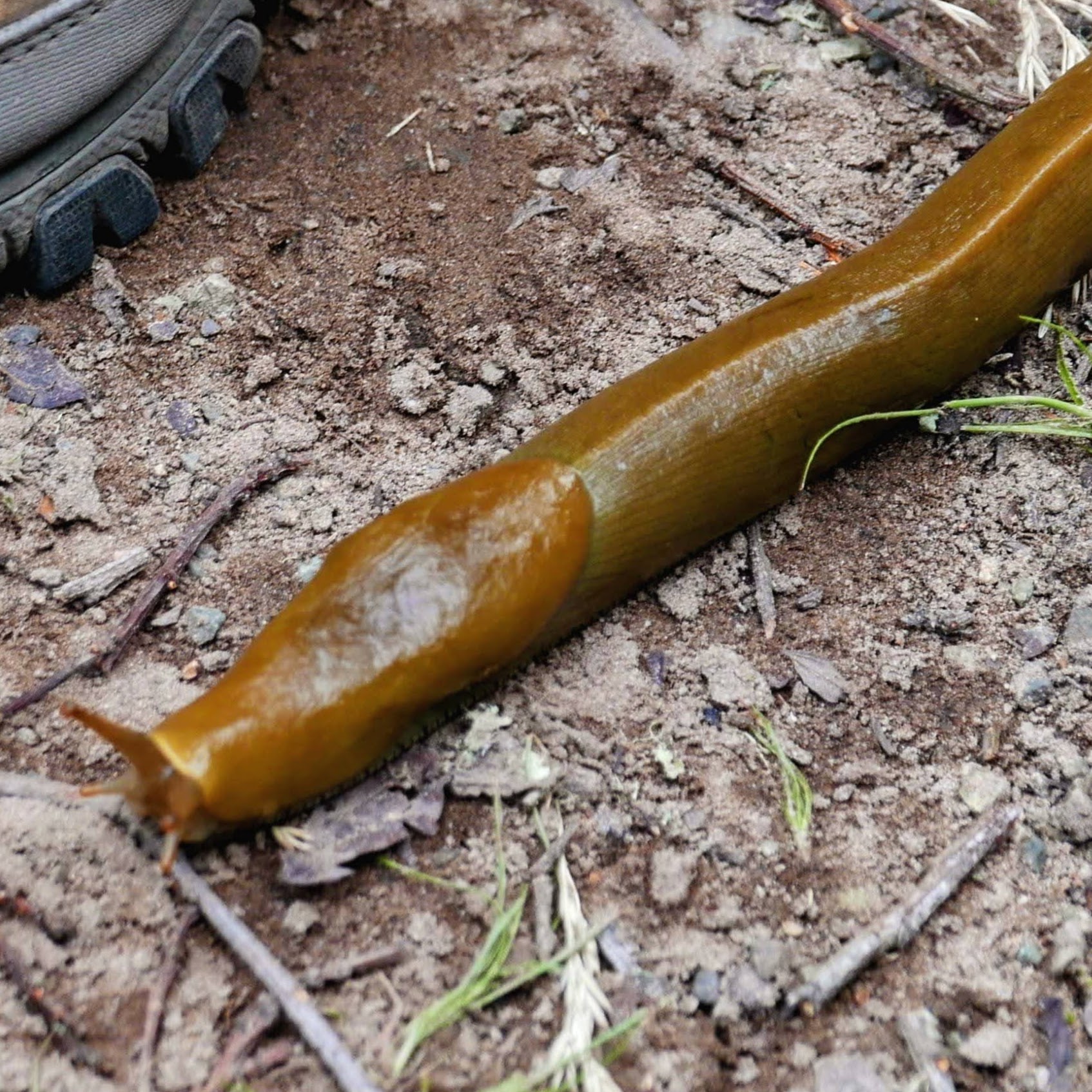
On July 18th, 2024, we awoke to find route 101 had been replaced by a giant worm.
There was little of value to say about this. It was clear to rational observers that no scientific cause could be attributed to such a thing. Nonetheless, from exit 362 to 433, from San Jose to Fisherman’s Wharf, where once had been asphalt, now stretched 80 miles of taut, soft worm flesh.
That is not to say there was no cause for alarm. Instantaneously the heart of the road network was blocked, and every ventricle of side street was clogged with commuters, redirected toward the fastest non-worm route. Quiet suburbs were flooded with blaring car horns and rust-colored fumes. Every street, no matter how residential, was plundered in the sweet, sweet promise of destination.
The chaos, of course, would not be allowed to last. A state of emergency was declared, though there was much debate over exactly what qualified as essential travel. Eventually the matter was settled by means of the national guard issuing traffic tickets via helicopter--until the roads were sufficiently cleared for the local police to resume their typical activities.
The congestion issue thus fined into compliance, the focus then turned to the long term. Though the area was riddled with long snakes of alternative routes, the loss of such a major avenue meant only the most vital transportation could feasibly be allowed, or the system would collapse back into eternal gridlock. Food, drink, emergency services was all the meager network could support. The transportation of people to fulfill those services would have to be filled as best as possible locally, and when they could not, would have to be grouped in batches--aka buses.
It was, of course, no small matter to adjust. Livelihoods upended. Families separated. Two-day shipping a dream of the past. But there was no disputing the existence of the giant worm of 101 and eventually, life in the bay area began to adapt.
With fewer vehicles through the lifeline of the remaining route 280 came fewer places these vehicles were willing to go. 18-wheelers dropped off their hauls of non-perishable supplies at the densest population centers and then moved on to the next. Over time, the population drifted ever closer to these centers. Then, having nowhere else to go, the people began to improve their surroundings--demolishing parking lots for parks and cafes, replacing office buildings with apartments, finding new ways to fulfill the less desperate needs of their new neighbors, like arts and entertainment.
There was an urge, however, that remained unslaked: dietary variety. Shelf-stable rations kept the population fed, but had the tendency to taste a little like its namesake--i.e. like a shelf. Fresh fruit and vegetables were a rare luxury on the ever-full caravan of the remaining network. This quickly priced them out of the reach of everyone except the exceptionally wealthy, who had all largely abandoned the bay area anyway. While pill bottle vitamins covered the nutritional deficiencies, they did nothing for the psychological ones. Eventually though, a solution emerged, from the worm itself.
It was hard to notice. At first the worm was awash in attention--from national news to tiktok and everything in between, crowds pressing at the barricades erected by the government to keep vehicles and pedestrians off of its sensitive and potentially dangerous flesh. But, once its biological functions were adequately documented, the barriers rapidly fell into decay as the government dismissed the worm as neither dangerous nor convenient enough to remove. At that point, due to its sheer scale, almost anyone with an interest could get an up close and personal view of it. But once the breaking news and novelty selfies had come and gone, most people tended to avoid the area--there was something unsettling about its 100 foot wide, translucent orange-red skin, the slow flex and shift of its segments. Over time its seismic movements had cracked and crumbled much of the surrounding infrastructure, which, given the disuse and the difficulty of transporting construction equipment, quickly entered and remained in a state of disrepair.
But as the months went by, it seemed the deterioration was a little faster than expected. While the highway itself had disappeared with the appearance of the worm, would the spines of on- and off-ramps have collapsed so quickly merely due to lack of maintenance? True, the churning of the earth accounted for the tearing of the asphalt and the sundering of concrete, but what about its dissolution first into sand and then later into clay?
It was not until the anticipated winter rains gave way to the usual drought of spring that it became truly apparent. As the hillsides and lawns regrew their annual coats of yellow-brown only then did people notice: in the midst of chronic drought, the wormland was verdant.
And not only moisture, but minerals and nutrients seeped from the worm’s slow-moving body. It, like garden variety earthworms, through its own consumption and burrowing through the terrain, seemed to be completing long broken cycles of renewal. And from it bloomed wildflowers, native brambles heavy with fruit, marshy biodiversity that the region had not seen in ages.
So, then, we sat down and asked ourselves, passing tubs of thimbleberries between us, how best to make use of this? Per our legacy of industrial agriculture, factory-scale farms were the first proposal: dense monocultures of trademarked genomes. But for all of their optimized yields and pest resistance, could the solutions really work without the support of a legion of specialized rivers of truck-delivered fertilizers?
No agreement could be reached, but none was needed. Some planted fields, others orchards, yet others merely cleared the way for the existing food-bearing inhabitants. Quickly though, with limited mechanical assistance, the hardiest and least labor intensive became the clear favorites, and a mix of native berries and orchard fruit found their ways on to dinner tables alongside the MREs.
As the gardeners learned what crops flourished in the worm soil, they brought their families, who brought their friends. Slowly, some of the communities drifted, others split, to nestle in the shade of the worm. And then suddenly, after months of being shunned for its strangeness--and before that decades for noise and fumes--the bed of 101 found itself at the heart of a string of communities, 80 miles long.
Then, one evening, as the children of the gardeners chased each other up the steep walls of the worm’s segments, while their parents relaxed in the dappled shade of the orchard, and their parents in turn walked hand in hand along the worm’s broad surface--there was a sound that had not been heard in a long time:
The low rumble of a cars’ engine, interspersed with grating thunks, as an Audi SQ8 teetered across each section of the worm.
The gardeners, their parents, their children, watched in silence as the car groaned down the worm, its wheels slipping along its pliant skin. A whiff of gasoline trailed through the cool evening air. No one spoke as it continued its lurching passage, until it had disappeared from both sound and sight.
The silence did not last long. Immediately a frenzy of questions exploded--who was the driver? How had the car even gotten up there? Was it safe? For us--for the worm?
The government had set up a research facility, down at the posterior of the worm. They began to test, driving vehicles of all shapes and sizes along the hill of worm skin, monitoring its excretions for any sign of chemical distress. After weeks of testing, they made a ruling: yes, the worm could be driven on. But only vehicles of 5000 lbs or less, and at most one per segment.
Reactions were mixed--only one per segment? That was barely at all. And at only 5k per vehicle, none of them would be carrying anything of any merit. Who would want to make the trip anyways, driving so slow to avoid skidding out, trundling up and down the groove of its segments?
The answer was: enough. The day after the government’s announcement the streets were flooded again. Maybe one in a thousand souls were tempted to embark upon such a limited journey, but that was still enough to fill the orchards with their foul fumes, drown birdsong with idling engines. There were few exits still in good repair, and fewer still that coincided with segments buried low enough for the cars, engines screaming in strain, to haul themselves up onto the worm’s round back.
The one per segment rule was broken within the hour.
There were arguments. There were protests. There were riots and marches and property damage. But the citizens of worm town were arrested for their outrage, and for the rest, the call back to the old way of life was too strong. Soon there were lines of cars, stretching all along the great length of the worm, idling and clunking and honking all through the terraces and fields of worm town.
After three months, the worm died.
Nobody noticed at first, so slow and continental were its movements. Even the government agency at its anus could not say exactly when it happened. Just that one day, its emissions had simply begun to drift--not quickly enough for concern, but never quite returning to normal. Its metabolism, already glacial, had merely slowed further and further, until homoeostasis became indistinguishable from the processes of the earth around it.
Likewise no one knew with certainty what might have killed it. Some blamed the weight limitations so flagrantly disregarded that very first day. Others, the ramps constructed to ease the cars on and off its round surface, which hung around its width like concrete shackles. Maybe it was the dirt and rubble packed in the crevices of its skin, done sometimes intentionally to smooth the ride, sometimes just by the accumulation of the debris of travel. Others blame the cars’ fumes, bathing its porous skin. Others the vibrations and the noise. But the mystery would have no resolution--the highway worm had been one of a kind, and now it was gone.
But even as we blamed ourselves, the worm left no retribution. As its carcass disintegrated it left behind no smell or fumes, only the smell of wet earth. Its skin softened, then darkened, then disintegrated. When it split at last, what it revealed was as dark and rich as the earth around it. Its leaving did not poison our waters or our crops. Instead, that spring they bore a bounty never before seen.
Years have passed, and now as the last of its remains return to the earth, they say that perhaps the story of the worm is over at last.
But as we gather together in the cool terraced valley of 101, our toes burrowing in its dark loam, we think to ourselves,
Maybe it doesn’t have to end.
Rebuttal to the Opposition of Proposition 11: Additional Funding for the Maintenance of State Highways
Without further investment, our highways will fall into disrepair. Our road networks are key to the health, happiness, and vitality of our cities. Modern life, after all, is impossible without highways...
Note to readers: The ending copy is a reference to the California ballot propositions, where individuals are allowed to vote directly on policy decisions. Each proposition is followed by a note by both the proponents and the opponents, and then a rebuttal from the opposite side.